
Does Kratom Show Up on a Drug Test? A Complete Guide

If you’re asking “Does kratom show up on a drug test”, you’re not alone. As the use of kratom products—like kratom powder, kratom capsules, kratom tablets, kratom gummies, Kratom Extract Shots, and potent 7-hydroxymitragynine products—continues to grow, more people want clear and accurate answers.
Whether you’re preparing for a job screening, dealing with probation testing, or simply trying to stay informed, this guide gives you a complete, research-based explanation in simple language.
Read more: Pure Leaf Kratom Review: Strains, Quality and Consistency
What Is Kratom and Why Do People Use It?
Kratom comes from a tropical tree called Mitragyna speciosa, native to Southeast Asia. People have used its leaves for centuries.
Today, manufacturers process kratom into different product types:
- Kratom powder (raw or brewed into tea)
- Kratom capsules (pre-measured and convenient)
- Kratom tablets (often stronger and more concentrated)
- Kratom gummies (flavored and easy to consume)
- Kratom Extract Shots (liquid, fast-acting formulas)
- High-potency 7-hydroxymitragynine products
Key Active Compounds
Kratom contains over 40 alkaloids, but two are most important:
- Mitragynine (primary compound)
- 7-hydroxymitragynine (more potent, present in smaller amounts)
Research shows that mitragynine makes up about 60–70% of kratom’s alkaloid content, while 7-hydroxymitragynine is much stronger but less abundant. These compounds interact with receptors in the brain, which is why kratom produces noticeable effects.
Growing Popularity (Research Insight)
According to national survey data (SAMHSA, 2022), about 1.7 million people in the U.S. reported using kratom in one year.
Common Reasons for Use:
- Pain relief
- Mood support
- Energy and focus
- Managing opioid withdrawal symptoms
What Are the Effects of Kratom?
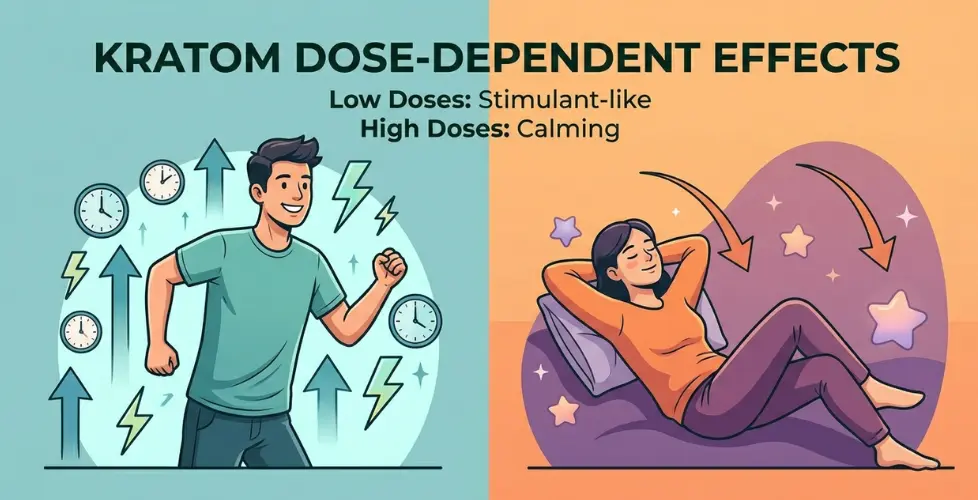
Kratom can produce different effects based on how much you take.
- Low doses often act as a stimulant. They may increase energy, focus, and alertness.
- Higher doses tend to have calming effects. They may help reduce anxiety, ease pain, and promote relaxation.
Some people also use kratom to manage opioid withdrawal symptoms. The effects usually start within a few minutes and can last for several hours.
Common Side Effects of Kratom
Kratom may cause mild to moderate side effects, such as:
- Nausea
- Itching
- Sweating
- Dry mouth
- Constipation
- Increased urination
- Faster heart rate
- Vomiting
- Drowsiness
- Loss of appetite
Serious Risks to Consider
In some cases, stronger or long-term use may lead to more serious effects, including:
- Weight loss
- Insomnia
- Liver problems
- Seizures
- Hallucinations
Do Standard Drug Tests Detect Kratom?
The short answer to “does kratom show up on a drug test” is: usually not. Most standard drug tests, such as 5-panel, 7-panel, and 10-panel screenings, are designed to detect:
- Marijuana
- Cocaine
- Amphetamines
- Opiates
- PCP
- Benzodiazepines
Kratom’s alkaloids are not included in these routine panels, so casual kratom users typically pass standard drug tests.
However, specialized tests do exist that can detect mitragynine and 7-hydroxymitragynine. These are usually ordered in:
- Military or safety-sensitive jobs
- Probation or court-mandated testing
- Substance use treatment programs
- Clinical or forensic evaluations
High doses of kratom can occasionally trigger false positives for opioids like methadone, even though kratom alkaloids work differently in the brain.
Read more: Kratom Powder vs Capsules: Which One Is Best For You?
When Can Kratom Show Up on a Drug Test?
Kratom usually doesn’t appear on standard drug tests, but it can show up in certain situations—especially depending on the type of test and product used (like kratom powder, kratom capsules, kratom tablets, kratom gummies, Kratom Extract Shots, or 7-hydroxymitragynine products).
Key Situations When Kratom Can Be Detected:
- Specialized Tests: If the lab specifically tests for mitragynine or 7-hydroxymitragynine, kratom will show up.
- Medical or Rehab Testing: Clinics and treatment programs may include kratom screening.
- Legal or Probation Cases: Courts may order extended drug panels that include kratom.
- Workplace Extended Panels: Some employers (especially safety-sensitive jobs) may request kratom testing.
- High-Potency Products: Strong options like Kratom Extract Shots or 7-hydroxymitragynine products are easier to detect.
- Contaminated Products: Low-quality kratom gummies or extracts may contain other drugs that trigger a positive result.
👉 Kratom only shows up if the test is designed to detect it.
How Long Does Kratom Stay in Your System?
Whether does kratom shows up on a drug test depends on the type of test used, the amount taken, and your body’s metabolism.
| Test Type | Detection Window | Notes |
| Urine | 3–7 days | Longer for regular users; occasional users may clear in 3–5 days |
| Blood | 24–48 hours | More sensitive but rarely used for routine testing |
| Saliva | 24–48 hours | Specialized tests exist but are uncommon |
| Hair | Up to 90 days | Detects long-term use; rarely done for kratom |
Factors affecting detection:
- Frequency and dose: More frequent or higher-dose use increases detection time.
- Metabolism: Age, liver function, kidney function, and body composition all affect how quickly kratom clears.
- Hydration and diet: Staying hydrated may shorten detection windows.
Read more: Does Kratom Get You High? Effects, Risks, and Proper Dosage
How Drug Tests Detect Kratom (Scientific Explanation)
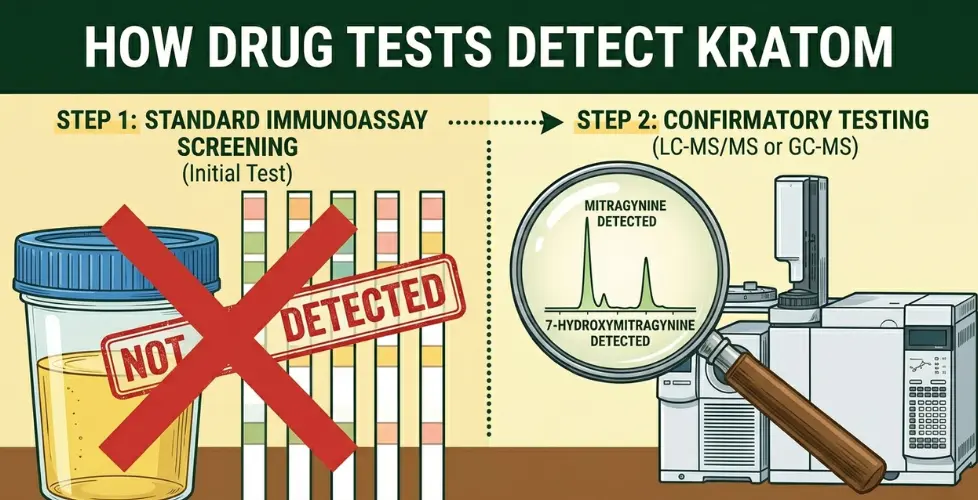
Understanding how drug tests detect kratom helps explain why it usually doesn’t appear on standard screenings—and when it actually can.
Kratom contains unique compounds like mitragynine and 7-hydroxymitragynine, which are not included in routine drug test panels. Because of this, labs must use specific scientific methods to identify these compounds.
Let’s break this down in simple terms.
Why Standard Drug Tests Don’t Detect Kratom
Most drug tests use immunoassay screening, which works like a filter.
- It looks for specific drug structures (like THC or cocaine)
- If the substance is not on the list, the test ignores it
👉 Since kratom’s alkaloids (mitragynine and 7-hydroxymitragynine) are chemically different from common drugs, standard tests do not detect them.
Step 1: Immunoassay Screening (Initial Test)
When labs test for kratom, they often start with immunoassay screening.
How It Works:
- The test uses antibodies to detect specific compounds
- If kratom is included, the test looks for mitragynine
- It flags a presumptive positive if detected
Detection Level:
- Typically around 5 ng/mL cutoff
👉 This step is fast and cost-effective, but not fully precise.
Step 2: Confirmatory Testing (LC-MS/MS or GC-MS)
If the first test shows a possible result, labs perform confirmatory testing using advanced technology.
🔬 LC-MS/MS (Liquid Chromatography–Mass Spectrometry)
This is the gold standard for detecting kratom.
How It Works:
- Liquid chromatography separates compounds in a sample
- Mass spectrometry identifies each compound by its molecular structure
What It Detects:
- Mitragynine
- 7-hydroxymitragynine
- Sometimes related compounds (like pseudoindoxyl forms)
Detection Sensitivity:
- As low as 1 ng/mL
👉 This method is extremely accurate and can confirm even tiny amounts.
🔬 GC-MS (Gas Chromatography–Mass Spectrometry)
Another reliable method used in some labs.
- Similar process to LC-MS/MS
- Converts compounds into gas form for analysis
- Identifies exact chemical fingerprints
Read more: 7-Hydroxymitragynine vs Kratom comparison: Which is stronger?
Different Sample Types Used for Kratom Testing
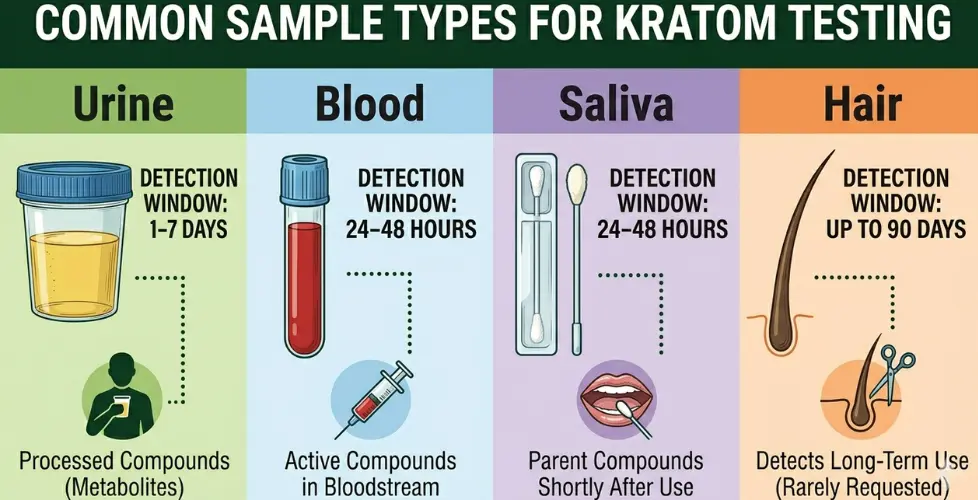
Different drug tests use different sample types, so does kratom show up on a drug test depends on the method used, as each test detects kratom compounds like 7-hydroxymitragynine at different timeframes based on how your body processes it.
🧪 Urine Testing
- Most common method
- Detects kratom metabolites (processed compounds)
- Detection window: 1–7 days
👉 Best for identifying kratom in urine test use over several days.
🩸 Blood Testing
- Detects active compounds in the bloodstream
- Detection window: 24–48 hours
👉 Used for recent use detection.
👅 Saliva Testing
- Detects parent compounds shortly after use
- Detection window: up to 48 hours
👉 Useful for very recent exposure.
💇 Hair Testing
- Detects long-term use
- Detection window: up to 90 days
👉 Rarely used unless specifically requested.
How Long Does Kratom Stay in Your System?
Kratom has a relatively long half-life of around 24 hours or more, which means it can stay in your body for several days after use.
⏳ General Detection Timeline:
- Occasional users → 1–3 days
- Moderate users → 3–5 days
- Heavy or regular users → 7–10 days
⚡ Strong Products Stay Longer
More concentrated products tend to remain in your system for a longer time, especially:
- Kratom Extract Shots
- 7-hydroxymitragynine shots
These products contain higher levels of active compounds, so your body takes more time to process and eliminate them.
Factors That Affect Kratom Detection

Several important factors determine does kratom show up on a drug test and how long it stays in your system.
- Dosage & Usage Patterns: Higher amounts stay in the body for a longer time. When someone uses it frequently, it can build up in the system, which extends the detection window compared to occasional use.
- Frequency of Use: Occasional use usually clears faster, often within a few days. In contrast, regular or heavy use leads to accumulation, which means it may remain detectable for a longer period.
- Product Strength & Form: More concentrated forms tend to stay in the body longer, while less concentrated forms are processed and eliminated more quickly.
- Metabolism & Individual Factors: Your body’s metabolism plays a major role in how quickly it is cleared. People with faster metabolism eliminate it sooner, while those with slower metabolism may retain it longer. Age, body composition, and overall health also influence this process. Additionally, with a half-life of around 24 hours, it takes time for the body to fully eliminate it.
- Liver and Kidney Function: The liver and kidneys are responsible for processing and removing substances from the body. If these organs are not functioning properly, elimination slows down, which can increase detection time.
- Hydration and Diet: Staying well-hydrated helps the body flush out substances more efficiently. Diet and meal timing can also affect how quickly it is absorbed and processed.
- Type of Drug Test: Detection depends on the type of test being used. It will only appear if the test is specifically designed to identify its compounds.
Detection depends on several factors, including usage habits, body characteristics, and the type of test being used—not just use alone.
Read more: Kava vs Kratom Which One Should You Choose?
What Does Kratom Withdrawal Feel Like?
Kratom withdrawal can feel uncomfortable, especially for people who use it regularly or in high doses. While it is often described as milder than traditional opioid withdrawal, it can still be difficult and may affect both your body and your mood.
The experience depends on how often you use kratom and what type you take—strong options like Kratom Extract Shots, kratom tablets, or high-potency 7-hydroxymitragynine products may lead to more noticeable withdrawal symptoms compared to basic kratom powder vs kratom capsules.
Why Does Kratom Withdrawal Happen?
Kratom contains compounds like 7-hydroxymitragynine and mitragynine that interact with opioid receptors in the brain. Over time, your body gets used to these effects.
When you stop using kratom suddenly:
- Your body needs time to adjust
- Brain chemistry changes
- Withdrawal symptoms begin
This is similar to how other substances cause dependence.
Common Kratom Withdrawal Symptoms
Kratom withdrawal includes mental (psychological) and physical symptoms.
🧠 Psychological Symptoms
These affect your mood and thinking:
- Anxiety
- Irritability
- Depression or low mood
- Restlessness
- Mood swings
- Difficulty focusing
- Strong cravings for kratom
Many users say these mental symptoms feel like a mix of stress and emotional discomfort.
💪 Physical Symptoms
These affect your body:
- Muscle aches and joint pain
- Runny nose
- Sweating
- Nausea or vomiting
- Loss of appetite
- Fatigue or low energy
- Insomnia (trouble sleeping)
- Tremors (shaking)
These symptoms are similar to a mild flu or opioid withdrawal.
Does Kratom Show Up as an Opioid on a Drug Test?
Kratom does not show up as an opioid on a standard drug test. This is because its main compounds—mitragynine and 7-hydroxymitragynine—are chemically different from traditional opioids, so routine drug panels do not detect them as opiates.
However, there is an important exception. Some low-quality or unregulated kratom products—such as certain kratom powder, kratom capsules, kratom gummies, or Kratom Extract Shots—may be contaminated or mixed with other substances, including opioids like fentanyl, heroin, buprenorphine, or morphine.
👉 If someone unknowingly uses contaminated products, they could test positive for opioids, even though pure kratom itself would not cause that result.
Tips to Reduce Risk Before a Drug Test
If you’re worried about a kratom drug test, follow these simple steps:
- Check the test type – Make sure you know if it’s a standard or specialized test.
- Limit your intake – Avoid high doses, especially close to the test date.
- Be cautious with strong products – Potent options like Kratom Extract Shots or 7-hydroxymitragynine products may stay longer in your system.
- Use quality products – Stick to trusted, lab-tested sources to reduce the risk of contamination.
- Give your body time – Stop use early and allow enough time for your body to clear kratom naturally.
Legal Status of Kratom in the United States
Kratom is legal at the federal level in the United States, but its rules differ depending on the state or local jurisdiction. Many states and cities allow adults to buy and use kratom freely, while a few states—including Alabama, Arkansas, Indiana, Vermont, and Wisconsin—have banned kratom completely.
In other states, you might ask, “Is kratom legal?” The answer is yes—but it often comes with regulations such as:
- Restricting sales to minors
- Requiring proper labeling of kratom products
- Mandating quality testing to ensure safety and accurate alkaloid content
Since kratom is classified as a dietary supplement and is not approved by the FDA, it remains largely unregulated, and its use continues to be part of ongoing public health debates.
Read more: Is kratom legal? Everything you need to know about kratom legality
When Should You Seek Help for Kratom Use?
You should consider seeking professional support if your kratom use has moved beyond occasional experimentation and is starting to affect your life. Signs that it may be time to get help include:
- Struggling to stop or reduce use despite wanting to
- Experiencing withdrawal symptoms when not using
- Relationship conflicts or tension due to substance use
- Declining performance at work, school, or daily responsibilities
- Financial strain caused by purchasing kratom
- Using kratom to manage stress, anxiety, or other emotions
- Hiding your use from family or friends
- Worrying about drug tests, legal issues, or other consequences
Frequently Asked Questions (FAQs)
Here are some frequently asked questions (FAQs) to help you understand kratom, its effects, and how it interacts with drug tests.
1. Does kratom show up on a drug test?
No, kratom usually does not show up on standard drug tests like 5-panel or 10-panel screenings. However, specialized tests that specifically check for kratom compounds can detect it.
2. Can hair follicle drug tests detect kratom?
Hair tests can detect substances for up to 90 days, but they rarely include kratom in standard screening. Only specialized hair tests designed for kratom can identify it.
3. Can blood tests detect kratom?
Yes, blood tests can detect kratom, but only for a short period. Kratom is usually detectable in blood for about 24 to 48 hours after use.
4. Can saliva testing detect kratom?
Saliva tests can detect recent kratom use, typically within 24 to 48 hours. However, kratom is not commonly included in standard saliva drug tests.
5. How long does kratom stay in the body?
Kratom can stay in the body for several days. For most users, it remains detectable for 1 to 7 days, depending on dosage, frequency, and metabolism.
6. What should I do if I’m worried about failing a drug test because of kratom?
First, find out what type of drug test you will take and whether it includes kratom screening. Avoid high doses before testing and allow enough time for your body to clear it. If needed, be honest with the testing authority, especially in medical or legal situations.
7. Does kratom show up on a urine drug test?
Kratom does not show up on standard urine drug tests. However, specialized urine tests can detect kratom compounds for up to a week after use.
Final Thoughts
So, does kratom show up on a drug test? In most cases, the answer is no. Standard workplace drug tests, including 5-panel and 10-panel screenings, do not check for kratom. This means common forms like kratom powder, kratom capsules, kratom tablets, and kratom gummies typically won’t appear in routine testing.
However, kratom can be detected if a specialized test is used. Advanced lab methods can identify compounds like 7-hydroxymitragynine, especially in settings like rehab programs, medical evaluations, or certain legal and safety-sensitive situations. Stronger products such as Kratom Extract Shots and concentrated 7-hydroxymitragynine products may also stay in your system longer and increase detection chances.
The key takeaway is simple: know your test and use it responsibly. While kratom usually won’t affect standard drug screenings, factors like product type, dosage, and frequency still matter. Staying informed helps you avoid surprises and make safer decisions for your health and future.